

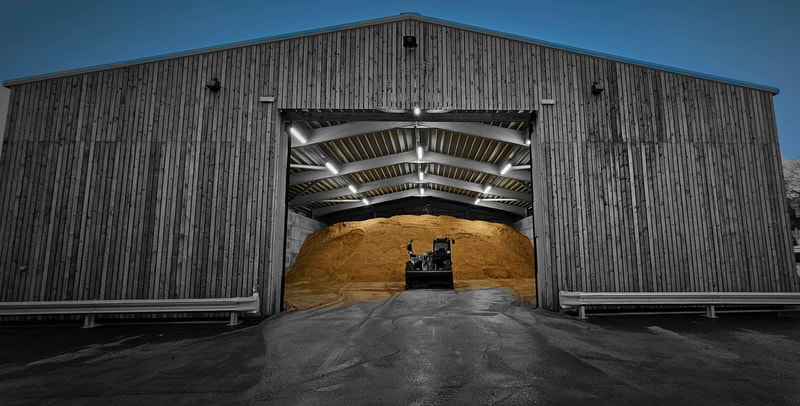
Drivers, gritters and barns are ready for another Oxfordshire winter
As winter approaches, Oxfordshire can boast a full complement of 55 specialist drivers to keep its 30 gritter lorries moving whenever the freezing weather strikes.
To make sure the county is ready when temperatures drop below zero, Oxfordshire County Council and its principal highways contractor M Group also have three barns at its depots in Deddington, Drayton and Woodcote containing more than 10,000 tonnes of road salt in total.
Councillor Liz Leffman, Oxfordshire County Council’s Cabinet Member for Highways Construction and Repairs, said: “We are committed to keeping our network of major roads free from ice and snow to minimise the risk of accidents and ensure that traffic can flow smoothly. Our gritter drivers do an incredible job at the most unsociable hours and in the coldest temperatures to help us achieve this.
“However, motorists should never assume that a road will be free from ice and need to adjust their driving to suit the conditions. If you do find yourself behind one of our gritter lorries, which are restricted to 30mph when they are working, please be patient and considerate – remember they are there to keep you safe.”
Last winter, the gritters were sent out 34 times – including on Christmas Eve, Christmas Day and Boxing Day – using a total of 6,184 tonnes of salt.
Richard Lovewell, M Group Business Director, said: “A huge amount of work takes place for months behind the scenes to make sure Oxfordshire is ready for whatever winter brings.
“Winter maintenance is a round-the-clock operation that relies on careful planning, accurate weather forecasting and the commitment of our frontline teams.
“Many of our gritter drivers also carry out highway maintenance work during the day, and we're proud of the role they play in helping residents, businesses and visitors travel safely throughout Oxfordshire in the winter months.”
The council uses several methods to decide when and where to salt.
It receives regular weather forecasts for conditions on Oxfordshire’s roads, uses a computerised ice prediction system to compare forecast conditions against actual road temperatures, and monitors conditions through the night. It also utilises the skills of experienced staff to judge when to best carry out precautionary gritting.
While Oxford City Council looks after the gritting inside the Oxford ring road, Oxfordshire County Council has responsibility for the rest of the county – including all A-roads, B-roads and some C-roads, apart from the M40, A43 and A34, which are covered by National Highways.
The county is spilt into three geographical zones – north, central and south. Most of the time all three are gritted. However, when temperatures vary between areas, some may require no action.
Regular updates on gritting activity can be found on the winter pages of the council’s website. Messages will also be posted on the council’s WhatsApp channel on nights when the gritters are due to hit the roads.
Every time they are called out to salt the whole county, Oxfordshire’s gritter drivers cover more than 1,200 miles, which is the equivalent of travelling from London to Iceland. They cover 25 routes – each taking about three hours – and will typically use a total of 240 tonnes of salt.
The gritting season starts at the beginning of November and usually lasts until the end of March, although the gritters will still be called into action outside of these dates if required.
The crews are based at the council’s three depots. The drivers all have day jobs with the council, including filling in potholes, patching roads, and clearing drains.
On days when they are required to go out gritting, or clear snow using snow ploughs, they will be sent home early so that they are rested in time for their evening shift.
One treatment is usually sufficient for the milder winter weather but, if conditions are worse, the drivers can return to the depot to load up again and return to the roads. In extreme cases, particularly involving snow, another team of drivers may even be called in to take over.
The fleet of gritting vehicles consist of 15 26 tonne trucks, 12 18 tonne vehicles, two 7.5 tonne trucks and one 3.5 tonne ‘baby gritter’, to treat very narrow roads and the park and rides.
Last year they were given Oxfordshire-inspired names – including Alfred the Grit, Inspector Norse and Radiospread – to spread some cheer as well as grit while they did their rounds. People can follow their journeys on cold winter nights through the online gritter tracker.
Sign up to hear from us and receive the latest news and updates in our fortnightly newsletter, Your Oxfordshire.